


This essay was written by Aiden Sagerman who is a PhD student in History of Science at Harvard. His interests span histories of mathematics, quantification, and race and eugenics. He holds a BA in Mathematics and Comparative Literature and Society from Columbia University and an MPhil in History and Philosophy of Science from the University of Cambridge, where he was a Gates Cambridge scholar. He is a grantee of the 2026 tranche of Analogue Group’s Revival Fund.
What does it mean to do mathematics?
Mathematicians have long distinguished between two kinds of practitioners: theory-builders and problem-solvers. As the mathematician Timothy Gowers explained in “The Two Cultures of Mathematics”, theory builders view solving mathematical problems as useful because it allows us to understand mathematics as a whole better. Problem-solvers, by contrast, want to understand mathematics so that we can solve more problems.
This distinction has become central for critics discussing the role of AI in mathematics. Much (digital) ink has been spilled over whether AI can build theory, whether it will ever be able to build theory, and whether building theory is the point of mathematics. Over the past few months, the mathematician Daniel Litt, for instance, has emphasized that although AI has solved a number of problems, these solutions largely do not involve producing new theory or deep concepts. Similarly, in September a declaration signed by 25 Fields medalists emphasized the theory builder perspective: “Solving problems is only a tool and proxy for achieving the primary goal of conceptual understanding and insight.” Gowers, also a Fields medalist, however objects, arguing that a mathematical community consists of a spectrum of mathematicians from theory-builders to problem-solvers. In his view, to declare that AI cannot do real mathematics because it does not pursue conceptual understanding is tantamount to telling many mathematicians—himself included—that they are doing math wrong.
For all their disagreement about whether theory-building is the point of mathematics, both camps write as though they agree on what it is. Gowers, for instance, conflates his own category of “theory-building” with the medalists’ “conceptual understanding and insight” without remark. But is all conceptual understanding necessarily theory? “Theory” evokes the idea of generality, rather than a specific problem. But is generality necessarily more insightful? What sort of mathematical activity produces insight? How is insight communicated? In other words, I want to ask: what makes good theory?
If the mathematics of the present is too wrapped up in concerns about AI to unravel this question, then insight can be gleaned by turning to the mathematics of the not-so-distant past. For the past few months I have been working with The Revival Fund to excavate modes of visual reasoning in twentieth-century topology. I started this project hoping a historical case could make the terms of the theory-building debate more precise. If theory-building is a distinct activity, it should leave traces in the working record of a field that did a great deal of it; diagrams in topology seemed a good place to look for these traces. What diagrams show, I argue, is the range of intuitions that go into making a theory into good theory. At the same time, however, thinking about diagrams shifts our focus away from how theories are made to how theories are spread. It is ultimately the communication of mathematics—through tools like diagrams that crystallize mathematical ideas, but also through social networks that need to be constantly maintained—that let theories take root and grow mathematics further.
To this end, I begin with a discussion of the history of diagrams in topology and their role in developing new theory. While the diagrams used by early topologists disappeared as the subject became abstract, new types of diagrams were actually central to the development of new theory. I then turn to how topologists used diagrams as a tool of communication, emphasizing that theory is only good if it can be communicated. Finally, I zoom out to think about the social networks that made possible this theory development in the first place. Each of these three places diagrams appear—invention, communication, and the social world—provides insight into how we should think about the relationship between AI and mathematics.
Diagrams in Early Topology
Visualization does two kinds of work. It helps simplify problems to intuitive cases we can reason through informally. But it also provides a foundation for how theory should be organized, as the case of commutative diagrams shows. To understand the significance of commutative diagrams, we need to turn to the history of diagram use in topology more broadly.
Visualization has long been at the center of topology, the mathematical field that studies space without notions of distance. For contemporary mathematicians, the central image defining the field is an image of a coffee cup transforming into a donut: lacking any essential structural features like holes, the bowl of the cup is stretched down into the handle and slowly smoothed out.
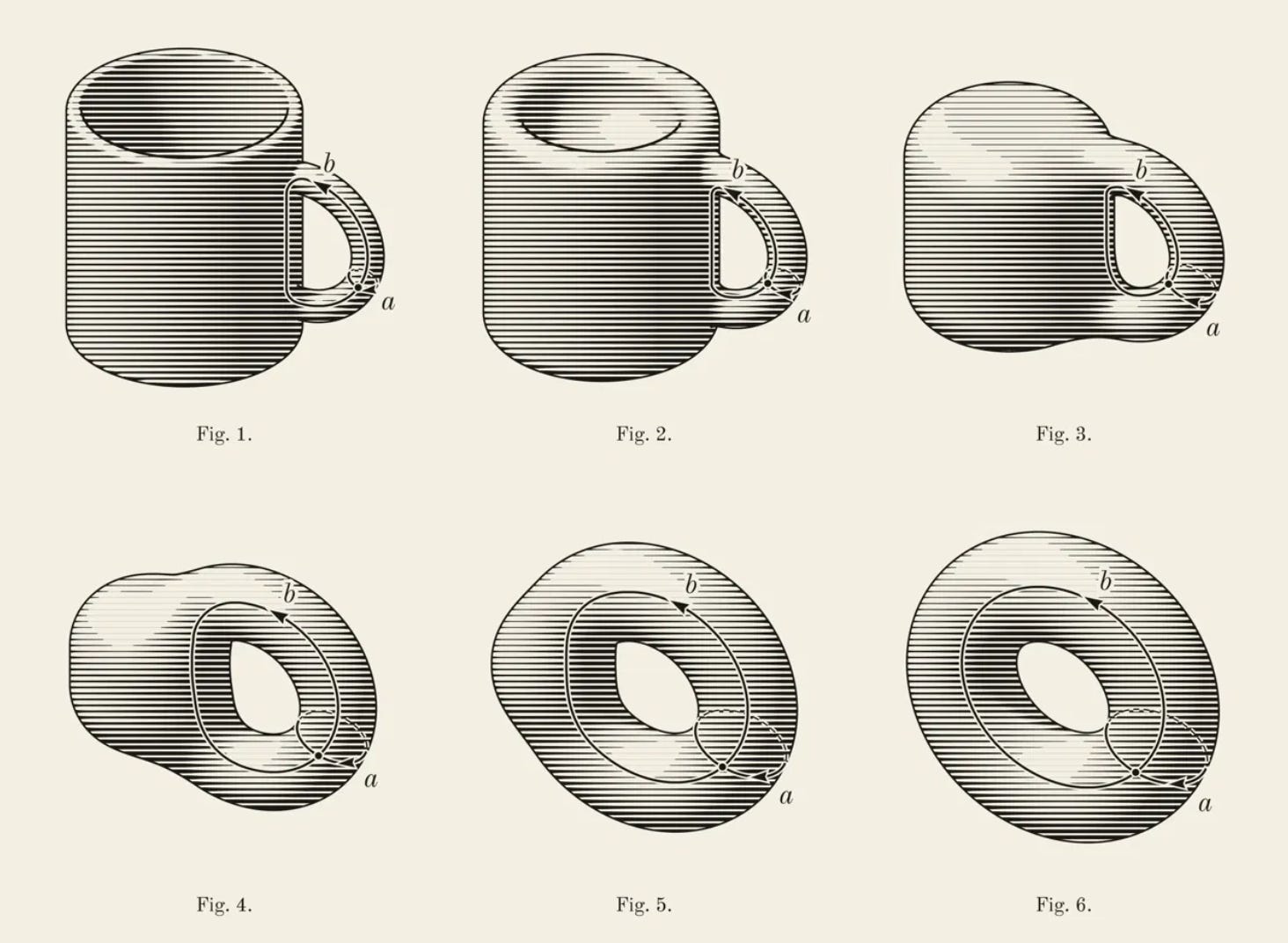
Originating in Henri Poincaré’s 1895 paper Analysis Situs, the earliest work in topology had relied on ideas like loops in space and deformations of geometric objects that could easily be visualized. These tools allowed for the discussion of structural invariants like holes—no matter how much you squish the hole in the center of a donut, the loop around the outside of it will never go away—but they were difficult to write down in algebraic formalism. Consequently, topologists in the early twentieth century drew lots of pictures, pictures that instructed readers in how to visualize concepts, convert objects between two- and three-dimensional representations, and cut objects up, stretch them, and glue them back together.
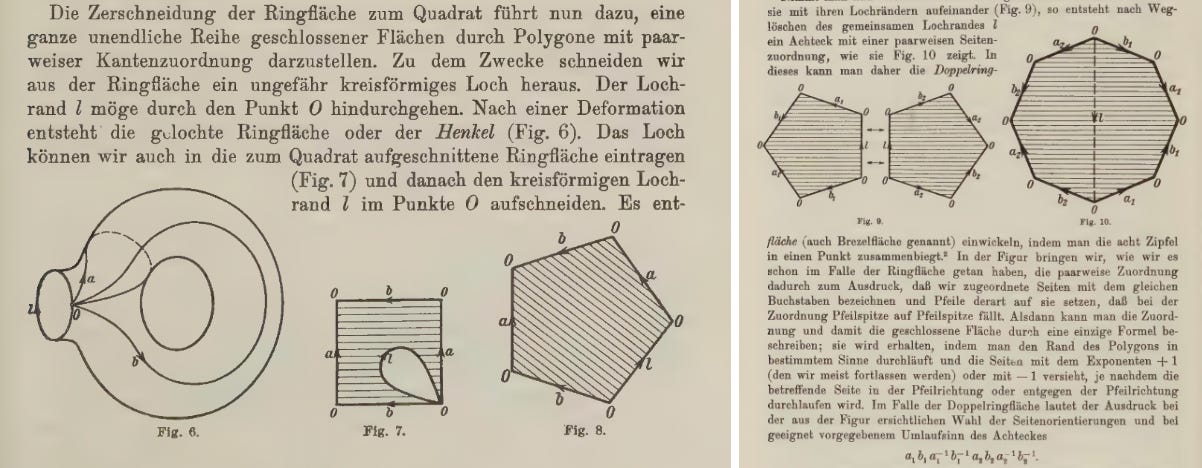
But as mathematicians found careful definitions for the intuitive ideas in topology and the subject grew more abstract, algebraic, and formal, pictures started to disappear. In the early twentieth century, topologists measured geometric information in ad hoc ways, like dividing up objects into triangles and using the triangles to build sub-objects like holes; it remained an open question whether such procedures worked for every sort of object topologists were interested in. The new topology, called algebraic topology, replaced nitpicky geometric constructions with algebra. Through complex but generally applicable procedures, topologists would study geometric objects by assigning algebraic data to them—say, a number, or something like a ‘number system,’ that loosely counts the ‘number of ways to walk around a hole’ in a shape. By 1942, the Russian-American mathematician Solomon Lefschetz’s textbook Algebraic Topology, an exposition of the major ideas in the field, relied entirely on text and equations. As one reviewer noted, the book explained topology in a “very general and abstract form” that had “largely lost touch with geometry.” “Most strikingly,” he added, “there is not a single figure.”1
Category Theory and Commutative Diagrams
And then something strange happened: pictures came back. Published ten years later in 1952, Samuel Eilenberg and Norman Steenrod’s Foundations of Algebraic Topology offered a very different vision of the field. As for Lefschetz, reviewers noted that Foundations was on the cutting edge of the field, providing the “first complete exposition” of many new “abstract” objects and “modernized” proofs. But in stark contrast to its predecessor, the new book was “rich in diagrams.” The reviewer added that “the technique of diagrams has become an almost indispensable assistant” not only in topology, but also in “algebra.”2
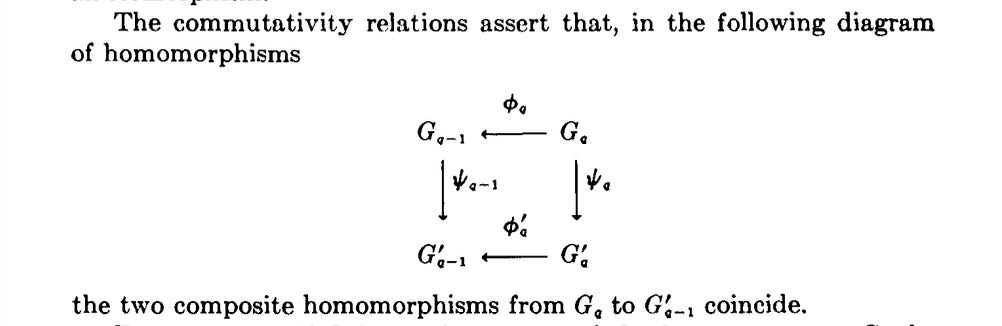
Unlike the geometric figures of previous decades that depicted shapes and their modifications, the diagrams of Foundations were a new, modern kind of visual mathematical inscription: the commutative diagram. Composed of arrows and mathematical symbols, commutative diagrams were a method for representing long, complex lists of algebraic equations in a compact, visual form. Following the arrows along the diagrams, readers were to infer that any “path” they took from one end to another—formally, a composition of functions—would render the same result. Whole proofs could be reduced to chasing an imaginary object around various paths of the diagram; this style of argumentation became known as “diagram chasing.”
As the reviewer noted, commutative diagrams quickly became ubiquitous not only in topology, but also in any field of mathematics that touched algebra in any way. One would be hard pressed to walk into any mathematics department at any major university today and not see one written on a chalkboard.
As they were originally designed, these diagrams were not just ubiquitous, but universal. Commutative diagrams gained popularity alongside the new mathematical discipline of category theory, an abstract language that allowed mathematicians to talk about a wide range of mathematical domains all at once—topology, algebra, geometry, logic, number theory—using only an abstract language of objects with arrows between them. The central innovation of Foundations was the use of the new language of categories and its new formalism of diagrams to explain algebraic topology.
It can be helpful to think of category theory through a linguistic metaphor. A category is like a language capturing a particular mathematical domain. The structure of the language is represented through objects and arrows between them—like topological spaces and continuous transformations, sets and functions between them, vector spaces and linear transformations, or even something as simple as numbers and arrows pointing from smaller to bigger numbers—that can be represented as diagrams. One category can be translated to another through something called a functor, a way of assigning the objects and arrows of one category to the objects and arrows of another without changing the structure of any of the diagrams.
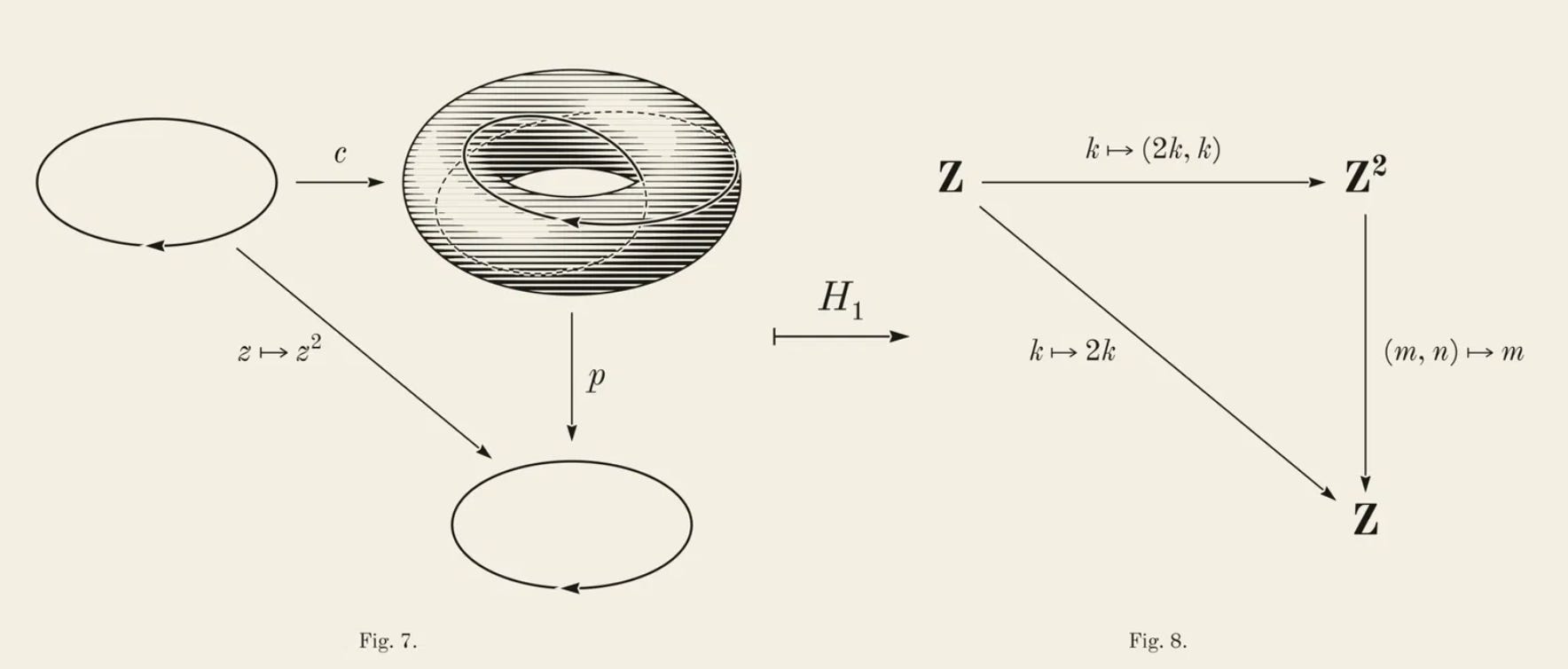
The development of category theory was intimately linked to algebraic topology. The basic tools of algebraic topology—all those ways of assigning algebraic data to geometric objects to tell them apart—could be understood as functors from the category of topological spaces to some sort of algebraic category. By preserving the structure of diagrams between the two categories, these functors transformed geometric relationships, like the embedding of a circle into a space, into algebraic ones; an example of how a diagram of geometric objects turns into a diagram of number systems (i.e., groups) is pictured above. The use of this categorical language actually simplified the practice of algebraic topology. Once mathematicians were able to translate the techniques of algebraic topology into the language of functors, they were able to quickly describe how many different techniques—say, the many different ways of “n-dimensional hole-counting” that had all been termed “homology,” after an idea from Poincaré’s paper—all referred to the same way of translating the language of topology into algebra.3 Eilenberg and Steenrod wrote in the preface to Foundations that the fundamental contribution of the text was this new axiomatization, given in the language of categories. Since homology is complicated, they explained, “there is need for a perspective and a pattern into which the student can fit the numerous parts. [...] the construction of homology groups is a long and diverse story, with a fairly obscure motivation. In contrast, the axioms, which are given in a few pages, state precisely the ultimate goal, and motivate every step of the construction.”4
But as much as category theory shaped algebraic topology, algebraic topology also shaped category theory. Eilenberg and Saunders Mac Lane, the theory’s creators, had originally been inspired to work together after noticing that entirely unrelated computations in topology and in algebra coincidentally always gave the same results.5 This question already raised the idea of translating across mathematical domains. What transformed this question into a theory, however, was a somewhat unexpected ingredient: the commutative diagram. Letters and archival descriptions show that diagrams were floating around algebraic topology in the early 1940s. In a private reflection from the 1990s, Eilenberg was adamant that commutative diagrams predated the development of category theory by at least 5 years. Moreover, he added, the central innovation was reconceptualizing functions notationally as arrows. In his 1971 textbook Categories for the Working Mathematician, Mac Lane made the point somewhat more directly: “Thus a notation (the arrow) led to a concept (category).”6 Even though diagrams had initially disappeared from algebraic topology as the subject became more abstract, it was precisely a new type of diagram that helped the subject find its modern, theoretical language.
Category theory would go on to transform not only algebraic topology, but mathematics as a whole, reaching areas such as logic, geometry, and algebra. Its language opened up new ways of doing mathematics. Most prominently, Alexander Grothendieck, an algebraic geometer widely considered the premier theory-builder of twentieth century mathematics, developed a new approach to problem-solving he termed the “rising sea.” Problems, Grothendieck argued, were like nuts: they could be cracked directly, or submerged in water so that it would eventually open itself. By analogy, his approach proposed building up more and more complex theoretical machinery; in practice, this meant increasingly complex definitions in the language of category theory. After building up this machinery, problems that once seemed intractable would fall easily. Diagrams, then, provided a theoretical language; this language would go on to produce more theory.
What are we to make of this central place of commutative diagrams in the invention of a mathematical concept? The recent AI record on visual reasoning has been mixed. Very few papers in the recent OpenAI release, for instance, were in low-dimensional topology, the subfield of topology that continues to rely the most on the kinds of geometric diagrams used before commutative diagrams were introduced around the midcentury.7 In other papers, commutative diagrams abounded; so too did commutative-style diagrams like flowcharts that schematically depict the structure of an argument with arrows without relying on specific mathematical formalisms. Papers in probability, convex and differential geometry, and partial differential equations sometimes used geometric schematics. But old-school depictions of topological objects and operations—knots or surgeries, for instance—were largely lacking. Here pictures largely illustrate, rather than providing full proofs. While this lack of recourse to the visual can impact problem solving, the example of category theory suggests it might impact theory-building even more. Good theory is good theory because it captures a wide range of phenomena and simplifies the process of proving theorems. But mathematicians are visual creatures who write their ideas down on paper and in chalk, and so good theory has to match with human understandings of what mathematical objects are and how they ought to be written down. My point is not that AI will never be able to come up with theoretical frameworks like category theory. Rather, if we want it to come up with theory that is also usable by and understandable to humans, we should try to train it to think like us. Learning to think in pictures might be a good first step.
Where did the Pictures Go?
The relationship between commutative diagrams and category theory shows how new, abstract forms of pictures can be central to the development of mathematical theory. But what about the old pictures? Were drawings of circles, toruses, and pentagons a premodern crutch no longer necessary in the era of modern theory? I have long been skeptical of this account. In a graduate course I took on topology with Mohammed Abouzaid—himself the executive director of First Proof, a mathematician-run project for benchmarking AI mathematics capabilities—many of our arguments consisted solely of pictures. These pictures often consisted of a mix of commutative diagrams and the older, more geometric style; in fact, sometimes a single diagram could be both. Historically, the answer to these questions is more complicated, and reveals a second way of thinking about the role of diagrams in mathematical understanding.
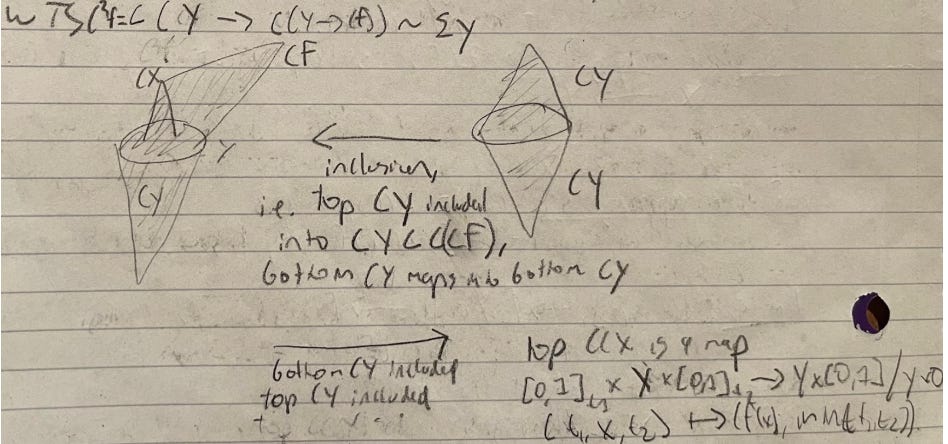
The textbook Foundations of Algebraic Topology provides an illustrative example. The book’s reviewer was correct to note that the only diagrams it contained were commutative diagrams. But printed texts tell an incomplete story. Though Eilenberg and Steenrod began as colleagues at the University of Michigan, by 1947 Eilenberg was a professor at Columbia and Steenrod at Princeton. The two exchanged letters with chapter-by-chapter drafts, and these letters were full of pictures. Some pictures were written directly in the text, demonstrating steps of key proofs; others, attached to supplementary letters, visualized examples they discussed elsewhere in abstract, symbolic language; and others still were scrawled on the back of pages of the draft to clarify ideas appearing in the main text.
Steenrod was by far the more visual thinker of the two. In his early mathematical training before he began a doctorate at Princeton, Steenrod’s work was deeply geometric. He sent drawings of complicated, fractal-like spaces to his undergraduate mentor, Raymond Wilder, to illustrate progress on research he was undertaking independently. As the historian of mathematics Alma Steingart notes, such pictures disappeared in his later letters as he became acclimated to the new climate of abstraction at Princeton.8 In this case, the shift away from pictures represented a shift in his interest from concrete problem solving to building abstract theory. But the reappearance of images in Steenrod’s later work demonstrates that pictures can be central to another part of mathematics: reading and writing.
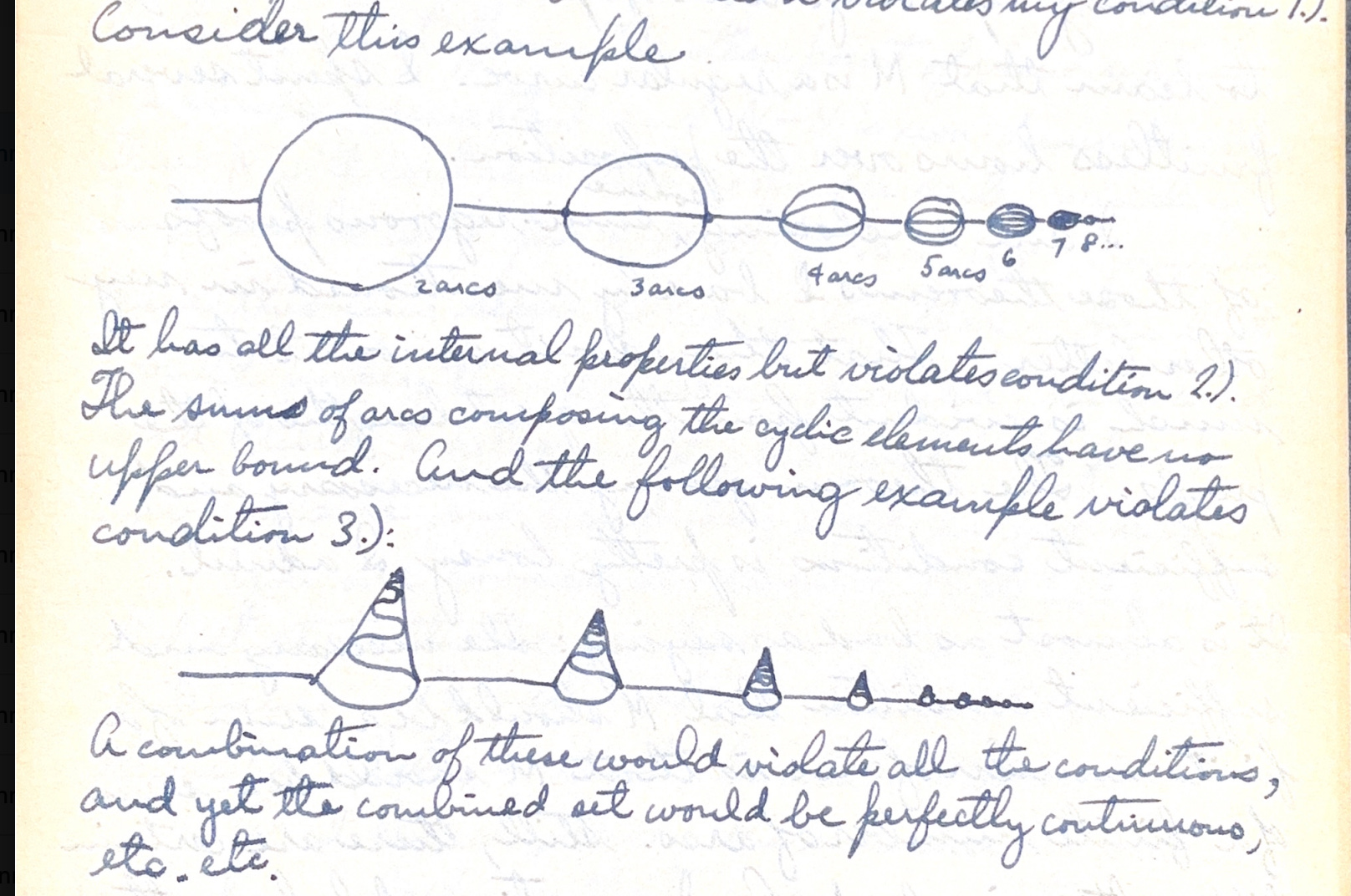
On an individual level, pictures help provide meaning. Put simply, mathematical writing is hard to read. Even when written carefully to be accessible to others, it takes time to translate text into understanding. The historian of mathematics Michael Barany and sociologist Donald MacKenzie term this process “reading down,” a dual process to the work of “writing up” that mathematical authors do to make their ideas stable and comprehensible for others in writing.9 Eilenberg and Steenrod’s draft contained new theoretical work (on products for [co]homology) not seen anywhere else—work that would not, ultimately, make its way into the final version of the book. As Eilenberg and Steenrod exchanged notes, drawing pictures was a key part of Steenrod’s process of reading down and making the ideas accessible—not only to others, but to himself. Pictures crystallize theoretical intuition for others to consume, but they are also an essential process of what it means to read mathematics at all. This is what accounts for their persistence, up to and including their place in my course notes.
One of the central complaints mathematicians have lodged against AI is about how it writes: too symbolically, too tersely for key arguments, at too much length for unimportant arguments, and without references. If AI is to communicate math well, as well as learn to write it, then turning as a guide to the long history of informal practices of writing down—including, but certainly not limited to, drawing pictures—is essential.
Topology’s Social World
So, diagrams help make new mathematical theory; they also help communicate theory, which allows it to take root in larger communities. Shifting the focus from the invention of mathematics to the communication of mathematics provides another way of looking at the story of diagrams.
Diagrams crystallize intuition into a small, mobile form. But diagrams do not move on their own; their exchange relies on fragile infrastructures of communication. Mathematics today operates in a globalized world, and the same was true of the mathematics of the twentieth century. However, the global mathematics of the 1940s was substantially less stable than that of today. Textbooks were all well and good, but to get the newest research, mathematicians needed access to articles. Articles moved slowly, and frequently had to be distributed in the form of reprints. As Michael Barany has documented, publishing played a central and complex role in maintaining the globalizing community of twentieth-century mathematics.10 11
However, at stake in this story of moving diagrams was not only the movement of papers, but the movement of people. A Polish Jew, Eilenberg fled to the US in 1939; buoyed by his overseas reputation, his American counterparts Solomon Lefschetz and Raymond Wilder were able to arrange for a position for him at the University of Michigan, enabling his immigration. Without this fragile international network of topologists, he likely would have not survived, let alone gone on to develop category theory or write Foundations of Algebraic Topology. Even outside of such dramatic events, in this period of somewhat less globalized mathematics location had a great impact on the sort of knowledge produced. Abstraction was all the rage at Princeton, where Steenrod did his PhD—at the encouragement of Wilder, who had trained at the much less algebraic University of Texas, Austin. Regional schools of mathematics thrived in a world where mathematical communication was partial, laborious, and materially complex; it was out of these regional schools that new mathematics developed.
At the center of these stories is the issue of trust. Despite having never met the American topologists, Eilenberg was able to secure his position on a mix of communal trust and belief in the value of his mathematical abilities, saving his life. As mathematicians themselves have highlighted, conditions of trust are essential to the smooth operation of the mathematics community12—and many accuse AI companies of violating this trust. With regard to AI solutions to First Proof problems, for instance, Daniel Litt has pointed to a cycle of “hype, then criticism from experts, then a slow walk-back to something still impressive but more reasonable” on the part of AI companies. The recent controversy between Tristan Buckmaster and OpenAI over the Navier Stokes counterexample is also indicative of a breakdown of trust between AI labs and the mathematics community, regardless of the veracity of any specific claims about OpenAI accessing Buckmaster’s chats or copying his work. Ultimately, mathematics still requires mathematicians to interpret it and to articulate its value; they are much more inclined to do so when community norms are maintained.
Conclusion
So, then, what does it mean to build good theory? Epistemically, theory has to capture certain intuitions about what mathematical objects are and how they should work; diagrams can sometimes serve as a guide to how these intuitions operate. To transform from individual conceptual understanding to something shared by a community and thus widely applicable, theory needs to be easily communicable. Good communication is not just about getting the right presentation, but about its recipients having tools—like diagrams—to transform abstract ideas back into something individually meaningful. Finally, this communication happens within a community. Communities are built on infrastructures that facilitate the movement of people and objects, but which are also fragile and need to be maintained. While these latter two points are not entirely unique to theory-building as an enterprise, they are certainly central to it. A discipline focused on solving concrete problems offers one vision of how mathematics is organized; this approach offers another.
I have already pointed to a few direct ways that turning to this historical moment might teach us about how to approach AI: the importance of training AI on visual intuition, of teaching AI to write up in a way that is compatible with how mathematicians read down, and of ensuring that AI labs maintain the norms of the mathematical community. More important than any individual lesson, however, is how midcentury mathematics helps provincialize how mathematics is organized today. It was not always the case that mathematicians could immediately download any new paper from arXiv, travel across a country to a conference, or Zoom with a colleague from across the world. Between the Republic of Letters and today, scientists and mathematicians have organized themselves in many different ways. To do so, they have had to produce a broad range of infrastructures for expanding the mathematical community outside of elite groups who can meet in the same room. These infrastructures have relied on trust, but also on limited information. The past does not suggest a single, normative way to organize mathematics in the future. But it does show how the world of freely circulating mathematical knowledge with obvious and clear authorial attribution has not always been, and how mathematicians have worked to communicate across distance and cultures, both literal and epistemic. As we think about how the community of mathematicians changes as new actors that do not communicate like mathematicians enter it, turning to the adaptable and varied infrastructures of the past can help us open up new visions of the field.
Hassler Whitney, review of Algebraic Topology, by Solomon Lefschetz, Mathematical Reviews MR0007093 (1943), https://mathscinet.ams.org/mathscinet/article?mr=7093
Henri Cartan, review of Foundations of Algebraic Topology, by Samuel Eilenberg and Norman Steenrod, Mathematical Review MR0050886 (1953), https://mathscinet.ams.org/mathscinet/article?mr=50886, author’s translation.
In fact, the first paper that proposed an axiomatic homology theory was Eilenberg and Steenrod’s “Axiomatic Approach to Homology Theory,” which was not written in the language of category theory. Eilenberg, however, had been working on category theory for a few years at this point, and everything would be properly categorified in Foundations. See Samuel Eilenberg and Norman Steenrod, “Axiomatic Approach to Homology Theory,” Proceedings of the National Academy of Sciences 31 no. 4: 117–120, doi:10.1073/pnas.31.4.117.
Eilenberg and Mac Lane, Foundations viii–ix.
Saunders Mac Lane, Saunders Mac Lane: A Mathematical Autobiography (A. K. Peters, Ltd, 2005), 99–104.
Saunders Mac Lane, Categories for the Working Mathematician (Springer-Verlag, 1971), 29.
While the division between subjects is somewhat blurry, within the 26 manuscripts in the topology section, certainly the paper for the purely cosmetic surgery conjecture, the two on 4-dimensional disk embedding, and the one on 4-dimensional Borel conjecture would count. Most of the section, however, deals with homotopy theory of various flavors.
Alma Steingart, Axiomatics: Mathematics and High Modernism (University of Chicago Press, 2023), 32–3.
Michael Barany and Donald MacKenzie, “Chalk: Materials and Concepts in Mathematics Research,” Representation in Scientific Practice Revisited 107 (2014).
Michael J. Barany, “Abstract Relations: Bibliography and the Infra-structures of Modern Mathematics,” Synthese 198, suppl. 26 (2021): 6277–90, https://doi.org/10.1007/s11229-020-02683-3.
As I hunted for mathematicians’ papers to find examples of diagrams, more and more often what I found instead were reprints. Many of the letters I read between mathematicians concerned the distribution of such texts, and the only trace I found of Eilenberg at the Columbia mathematics department, his longtime home, was a collection of reprints locked away in an old filing cabinet in the copy room. (I held on to the ones with the most interesting pictures.)
As with any other community of practitioners.